The charts are here:
https://www.dropbox.com/s/gfo8o4i03f1nt33/EinhornPolicyHistoryJune2014.pptx
Sunday, June 1, 2014

Wednesday, December 11, 2013
The Tariff, the Sugar Trust, and the Income Tax

Anyway, Richardson does not gloss this very complicated image or even mention the Sugar Trust at its center (the Wikipedia entry says little more). Richardson explains only that "tariffs symbolized a much larger struggle between rich and poor, employers and workers, capital and labor" in the late-19th century, which is true in only a limited if not downright simplistic sense -- as Richardson obviously knows as a leading scholar of the subject.
In her defense, Richardson wrote the posted essay for a children's magazine, called Cobblestone, that promises "to meet curriculum standards for history-social studies" in grades 5 through 9 while "bringing history to life with primary sources, lively graphics, historical photographs, and maps." It is odd that this lively graphic, if it survives in the published version, will remain mysterious to the students and teachers who ostensibly will be using it to understand tariff politics. We can also note the disheartening intrusion of conservative political ideology into this "classroom magazine" that "fosters an appreciation for the past while making connections to the present." The Cobblestone issue that will carry Richardson's essay in March 2014 was advertised under the title Robber Barons but is now set to be called Captains of Industry. And they say that policing the rhetorical boundaries of "political correctness" is a liberal preoccupation!
The point of the cartoon was that the Wilson-Gorman Tariff, by granting hefty tariff protection to the infamous Sugar Trust, constituted a political triumph for Senator Arthur Pue Gorman and a humiliating defeat for President Grover Cleveland and House Ways and Mean Chairman William L. Wilson, both of whom had championed major tariff reductions.
So: Gorman drives the chariot, Cleveland follows behind it in chains, and Wilson is crushed under the wheel. Cleveland has fallen from a pedestal and Wilson is dressed as a scholar for some reason (this is William L. Wilson, not Woodrow Wilson, who in 1894 was a 36-year-old Princeton professor only beginning to dip his toes into politics). The chariot is a sugar barrel and, in an especially nice touch, it is pulled by a donkey instead of a horse, signaling the fact that all three of these politicians were Democrats.
The party affiliation is significant. In the late-19th century, the Republicans were the party of high tariffs and the Democrats were the party of low tariffs. The Republicans had won a massive tariff hike in the 1890 McKinley Tariff (this time it was the future president, William McKinley). By 1894, however, with the Democrats controlling the presidency and both houses of Congress for the first time since the Civil War, everyone expected very big tariff cuts, not least as the party's response to a desperate economic situation. A stock market crash in 1893 had inaugurated what turned out to be four years of deep depression.
As the suffering spread, however, the Democrats proceeded to talk their tariff bill nearly to death. After the House, under Wilson's guidance, passed a bill with serious rate cuts in February 1894, the Senate, guided by Gorman, gutted it slowly by adding 634 separate amendments that hiked many of the protective rates, took until July to adopt, and then required a House-Senate conference committee that delayed the final bill into August. While the Senators dickered, "armies" of unemployed men crisscrossed the country, most famously Jacob Coxey's Army that marched from Massillon Ohio to Washington D.C., only to see their leader arrested for attempting to speak on the Capitol grounds. Then, when the massive Pullman Strike shut down much of the nation's rail traffic, Cleveland, over the furious objections of the Illinois governor (John Peter Altgeld), sent soldiers to Chicago to break the strike -- on the same day that the Senate finally passed its bloated tariff bill.
The Republicans swept back into power in 1896 and more than restored the high McKinley rates in the Dingley Tariff of 1897, just in time to let the protectionists take credit for the return of prosperity. The Wilson-Gorman Tariff, in other words, was a fiasco.
The bigger truth of the cartoon, however, addresses a totally different issue, the precise issue that Richardson may have had in mind in using it to illustrate the tariff's political significance. This issue is the fact that to the extent that anyone remembers the Wilson-Gorman Tariff today, it is not because of its protectionism in general or the cushy deal it handed to the powerful Sugar Trust (which controlled 85 percent of all sugar refining east of the Mississippi River). Today, we remember the 1894 tariff because it contained an income tax. This income tax was tiny, imposing 2 percent on income over $4,000, which was the equivalent of $108,000 today. The tax was also relatively uncontroversial. The House adopted it because they thought their major tariff cuts would cause large budget deficits and the conservative Senate did not touch it in any of its many amendments.
But the political significance of this income tax rocketed upward when the Supreme Court ruled it unconstitutional in Pollock v. Farmer's Loan and Trust Company (1895). The Pollock opinions, filled with hysterical rhetoric about class warfare, socialism, and anarchism, meant that the modern federal income tax would have to await the adoption of the Sixteenth Amendment in 1913.
The cartoon reminds us that protectionism and the Sugar Trust were the politically salient issues in 1894. The income tax had a big future, but it was basically trivial at the time.
Sunday, June 16, 2013
Tarrif politics: Free Tobacco and Whiskey
 |
| Puck, October 10, 1888 |
So, here we are again with the tariff in some of its grandeur as a complex partisan issue. The charge is dissipation and ruin as a result of Republican policies. The cat and the kids turn from the "empty flour barrel" to the open tap of "free whiskey," albeit whiskey whose label hypocritically designates it "for the promotion of temperance and morality." Dad struggles to draw on his huge pipe of "free tobacco," while Mom looks plaintive as she warms her hand over the bowl (the stove in the back is not being used) and holds the crying baby. If the Republicans win the presidential election in November -- "if Harrison and Protected Monopoly are victorious," as the caption explains -- then it will be Blaine rather than God who blesses the home.
Blaine, you ask? James G. Blaine was a Republican Congressman from Maine, Speaker of the House, Senator, Secretary of State, and perennial presidential candidate (he won the nomination in 1884 and then lost to Grover Cleveland). He was known as the "plumed knight" because another Republican politician had called him that in a nominating speech in 1876: "Like an armed warrior, like a plumed knight," Blaine had "marched down the halls of the American Congress and threw his shining lance full and fair against the brazen foreheads of every traitor to his country and every maligner of his fair reputation." There's some fine 19th-century bloviating oratory!
 |
| Wikipedia's portrait of Blaine |
I don't know if the "armed warrior" bit sounded at all untoward given
that Blaine spent the Civil War years (his early thirties) in Congress
instead of the Union Army, but the definitely ridiculous thing about
Blaine was the name of his Republican party faction. The Half-Breeds were so
called because they stood between the party's other ridiculously named factions: the Regular Republicans known as Stalwarts and the Liberal Republicans known as Mugwumps. Half-Breed meant something like not as corrupt as the Regulars were but not as clean as the priggish Mugwumps thought they were.
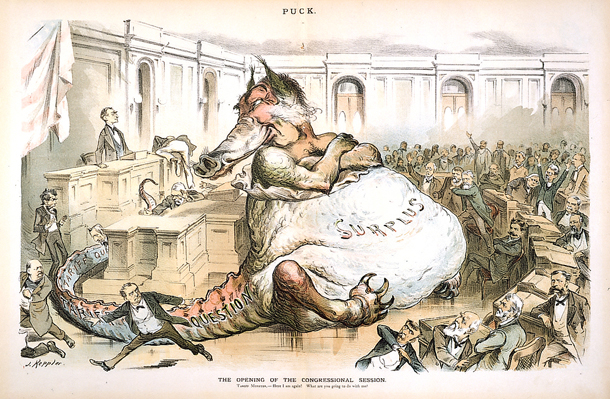
Anyway, back to the tariff. Puck, which supported free trade, was alluding to the problem of the federal budget surplus. Yes, that's right, the problem of the surplus. Nearly a year earlier, in a cartoon called "The Opening of the Congressional Session," Puck had represented the surplus as a kind of giant diaper on the monster of the "tariff question." There is no need to follow up on the diaper metaphor; the important point is the Tariff Monster challenging the terrified congressional leadership: "Here I am again. What are you going to do with me?"
The surplus was monstrous for Republicans because it suggested that tariff rates should be cut -- since they raised too much money -- but the Republicans wanted to keep the rates high because they were firmly committed to high-tariff protectionism. The other wrinkle here was that nobody knew whether rate cuts actually would increase or reduce the customs revenue. If the existing rates were high enough to discourage imports, then cuts would produce more imports and increase the revenue. If, on the other hand, the existing rates were not high enough to discourage imports, then cuts to the rates were more likely to reduce the revenue.
A possible solution, therefore, was to leave the high tariff rates alone and slash the federal excise taxes, which were levied mainly on alcohol and tobacco. The point was not to give these items away for free, as the cartoon suggests -- "free whiskey," "free tobacco" -- but it definitely was to reduce their prices through tax cutting. If you favored free trade, as Puck and the Democrats did, you would have wanted to keep the high domestic excise taxes instead of the high tariffs.
"If Harrison and Protected Monopoly are victorious," Puck was warning, children (and cats) would start knocking back the whiskey -- an argument that Democrats would have found especially delicious because of the Republicans' periodic bouts of moralistic temperance agitation. Not to mention the decision it forced on a potentially significant third party -- the Prohibitionists.
"Home comforts for the laborer and his family." When Blaine and the Republicans bless a home, they don't stop with debasing the people. They turn the cat into a drunkard too.
Anyway, back to the tariff. Puck, which supported free trade, was alluding to the problem of the federal budget surplus. Yes, that's right, the problem of the surplus. Nearly a year earlier, in a cartoon called "The Opening of the Congressional Session," Puck had represented the surplus as a kind of giant diaper on the monster of the "tariff question." There is no need to follow up on the diaper metaphor; the important point is the Tariff Monster challenging the terrified congressional leadership: "Here I am again. What are you going to do with me?"
 |
| Puck, December 7, 1887 |
A possible solution, therefore, was to leave the high tariff rates alone and slash the federal excise taxes, which were levied mainly on alcohol and tobacco. The point was not to give these items away for free, as the cartoon suggests -- "free whiskey," "free tobacco" -- but it definitely was to reduce their prices through tax cutting. If you favored free trade, as Puck and the Democrats did, you would have wanted to keep the high domestic excise taxes instead of the high tariffs.
"If Harrison and Protected Monopoly are victorious," Puck was warning, children (and cats) would start knocking back the whiskey -- an argument that Democrats would have found especially delicious because of the Republicans' periodic bouts of moralistic temperance agitation. Not to mention the decision it forced on a potentially significant third party -- the Prohibitionists.
"Home comforts for the laborer and his family." When Blaine and the Republicans bless a home, they don't stop with debasing the people. They turn the cat into a drunkard too.
Monday, June 10, 2013
The South and the Income Tax
My most recent paper, now "in production" at a journal to be identified if all goes well (as it should), is about Southern enthusiasm for the 16th Amendment. Warning: what follows is not a cute anecdote; it's a big piece of analysis.
Southerners loved the federal income tax in the early 20th century. In fact, seven of the first ten states to ratify the Sixteenth Amendment had been slave states during the Civil War: Alabama first, followed by Kentucky and then, of all things, South Carolina. White Southerners debated about whether strengthening the federal government in this way would be a problem -- specifically whether it would threaten their "racial order" -- but their financial incentives were simply too strong.
Here is some data I've just put together. First, notice the difference between 1916, 1926, and 1936 on the one hand and 1946 through 1976 on the other. This was the transformation of the federal income tax from a "class tax" levied only on the rich to a "mass tax" levied on, well, the mass of the population.

And how rich did you have to be to pay income tax in 1916? Well, look at the first page of that year's IRS Form 1040.
The personal exemption stood at $3,000 for a single person
(think $64,700 today) and $4,000 for a married person or a "family head" (think
$86,300). Then, of course, there were the various deductions.
We can also notice the rates in 1916. They were progressive, charging the very rich much more than the only sort-of rich, but at very low rates overall. The range spanned from a 1% bottom rate to a 13% top rate on income over $2 million (think $43.2 million). Today, the bottom rate is 10% and the top rate is 39.6%.
Southerners liked a tax that was levied only on the rich because few of the wealthy targets of this tax lived in the South. A whole lot of them lived in New York. With 10 percent of the U.S. population in 1916, New York State accounted not only for 20 percent of the tax returns, but also for a whopping 45 percent of the tax!
But the "mass" income tax did not mean that the South suddenly started sending large sums to the Treasury. If you scan across the last row of the table, you see the tax data registering the South's slow climb out of poverty. Southerners paid only 34 percent of the national average in 1916, 48 percent in 1936, 67 percent in 1956, and 87 percent in 1976.
For the early period, though, the overall regional figure for 1916 -- the 34 percent -- makes the South seem less poor than it actually was, since much of that came from a few states that we don't always even think of as South: Delaware, Maryland, and Oklahoma (with oil wealth). I made a map that dramatizes the true situation by showing the income tax per capita in the individual states.
Rich little Delaware came in at an extraordinary $15.75 (about $340 today). But except for Delaware, Maryland, and Oklahoma, (which had a lot of oil), the states with per capita averages over $1 were in the North: $6.97 in New York, $3.34 in Rhode Island, $2.76 in Massachusetts, and so on.
Then, there were the states that came in with per capita averages under a quarter: South Carolina at 6 cents, Alabama at 9 cents, Arkansas at 10 cents, Georgia at 15 cents. A few states outside the South also came in with very low averages, but Iowa was the only one of them with a large population.
So, yes, white Southerners rather liked the idea of giving the federal government the power to levy an income tax. As long, that is, as this expanded power to tax did not create a new "power to destroy" their oppression of African Americans. But it didn't. That required the Civil Rights Movement -- which had nothing to do with the federal income tax.
Southerners loved the federal income tax in the early 20th century. In fact, seven of the first ten states to ratify the Sixteenth Amendment had been slave states during the Civil War: Alabama first, followed by Kentucky and then, of all things, South Carolina. White Southerners debated about whether strengthening the federal government in this way would be a problem -- specifically whether it would threaten their "racial order" -- but their financial incentives were simply too strong.
Here is some data I've just put together. First, notice the difference between 1916, 1926, and 1936 on the one hand and 1946 through 1976 on the other. This was the transformation of the federal income tax from a "class tax" levied only on the rich to a "mass tax" levied on, well, the mass of the population.

 |
| Form 1040, 1916 |
We can also notice the rates in 1916. They were progressive, charging the very rich much more than the only sort-of rich, but at very low rates overall. The range spanned from a 1% bottom rate to a 13% top rate on income over $2 million (think $43.2 million). Today, the bottom rate is 10% and the top rate is 39.6%.
Southerners liked a tax that was levied only on the rich because few of the wealthy targets of this tax lived in the South. A whole lot of them lived in New York. With 10 percent of the U.S. population in 1916, New York State accounted not only for 20 percent of the tax returns, but also for a whopping 45 percent of the tax!
But the "mass" income tax did not mean that the South suddenly started sending large sums to the Treasury. If you scan across the last row of the table, you see the tax data registering the South's slow climb out of poverty. Southerners paid only 34 percent of the national average in 1916, 48 percent in 1936, 67 percent in 1956, and 87 percent in 1976.
For the early period, though, the overall regional figure for 1916 -- the 34 percent -- makes the South seem less poor than it actually was, since much of that came from a few states that we don't always even think of as South: Delaware, Maryland, and Oklahoma (with oil wealth). I made a map that dramatizes the true situation by showing the income tax per capita in the individual states.
 |
| I made this map myself. All rights reserved. |
Rich little Delaware came in at an extraordinary $15.75 (about $340 today). But except for Delaware, Maryland, and Oklahoma, (which had a lot of oil), the states with per capita averages over $1 were in the North: $6.97 in New York, $3.34 in Rhode Island, $2.76 in Massachusetts, and so on.
Then, there were the states that came in with per capita averages under a quarter: South Carolina at 6 cents, Alabama at 9 cents, Arkansas at 10 cents, Georgia at 15 cents. A few states outside the South also came in with very low averages, but Iowa was the only one of them with a large population.
So, yes, white Southerners rather liked the idea of giving the federal government the power to levy an income tax. As long, that is, as this expanded power to tax did not create a new "power to destroy" their oppression of African Americans. But it didn't. That required the Civil Rights Movement -- which had nothing to do with the federal income tax.
Monday, June 3, 2013
Tariff politics: "I'm not that kind of kitten."
 |
| Protect U.S. from John Bull: Protection Pictures from Judge (1888). |
For some reason, Britain, with the "J. Bull" feather in his cap, is figured as a monkey. The kitten, meanwhile, wears a ribbon identifying him as the Irish American voter. No idea what the Tin-Can Brigade is, or what the kitten's hat is supposed to be. The stove, however, is clearly labeled as American industries, powered by the coal of "prosperity," and the chestnuts being cooked seem to be British industries, that is, cloth, iron, cotton, wool, agriculture, and something illegible behind the kitten's arm.
The monkey sits on a London Times quotation: "The only time England can use an Irishman is when he emigrates to America and votes for Free Trade," meaning when Irish Americans vote for the Democrats, as they overwhelmingly did. The monkey asks the kitten to help get his chestnuts off the fire, presumably meaning British chestnuts cooked by American industrial prosperity, which the kitten answers by defending his virtue: "I'm not that kind of kitten."
So, for starters, both animals are clearly figured as male, so what's going on here is that the Irish American rejects the British homosexual advance by voting Republican -- which very few of them actually did.
But what's really significant here, as a historical matter, is that protectionism was a fully respectable political position and the position of the Republican party for nearly a century. Today, we might support tariffs for this or that particular industry, but our orthodoxy is certainly for "free trade" in general.
The other significant piece is the protectionist argument: that high tariffs were necessary to protect American workers against "pauper labor," often figured as British. Today, we most often think of it as Chinese. In the 19th century, the idea of "free trade" as British imperialism was not a stretch. Neither was appealing to Irish Americans to oppose the machinations of the British, a strategy known as "twisting the lion's tail." But convincing Irish American workers to vote Republican was a harder sell.
Especially if you were figuring them as gay sex kittens if they remained Democrats.
Subscribe to:
Posts (Atom)