 |
| Puck, October 10, 1888 |
So, here we are again with the tariff in some of its grandeur as a complex partisan issue. The charge is dissipation and ruin as a result of Republican policies. The cat and the kids turn from the "empty flour barrel" to the open tap of "free whiskey," albeit whiskey whose label hypocritically designates it "for the promotion of temperance and morality." Dad struggles to draw on his huge pipe of "free tobacco," while Mom looks plaintive as she warms her hand over the bowl (the stove in the back is not being used) and holds the crying baby. If the Republicans win the presidential election in November -- "if Harrison and Protected Monopoly are victorious," as the caption explains -- then it will be Blaine rather than God who blesses the home.
Blaine, you ask? James G. Blaine was a Republican Congressman from Maine, Speaker of the House, Senator, Secretary of State, and perennial presidential candidate (he won the nomination in 1884 and then lost to Grover Cleveland). He was known as the "plumed knight" because another Republican politician had called him that in a nominating speech in 1876: "Like an armed warrior, like a plumed knight," Blaine had "marched down the halls of the American Congress and threw his shining lance full and fair against the brazen foreheads of every traitor to his country and every maligner of his fair reputation." There's some fine 19th-century bloviating oratory!
 |
| Wikipedia's portrait of Blaine |
I don't know if the "armed warrior" bit sounded at all untoward given
that Blaine spent the Civil War years (his early thirties) in Congress
instead of the Union Army, but the definitely ridiculous thing about
Blaine was the name of his Republican party faction. The Half-Breeds were so
called because they stood between the party's other ridiculously named factions: the Regular Republicans known as Stalwarts and the Liberal Republicans known as Mugwumps. Half-Breed meant something like not as corrupt as the Regulars were but not as clean as the priggish Mugwumps thought they were.
Anyway, back to the tariff. Puck, which supported free trade, was alluding to the problem of the federal budget surplus. Yes, that's right, the problem of the surplus. Nearly a year earlier, in a cartoon called "The Opening of the Congressional Session," Puck had represented the surplus as a kind of giant diaper on the monster of the "tariff question." There is no need to follow up on the diaper metaphor; the important point is the Tariff Monster challenging the terrified congressional leadership: "Here I am again. What are you going to do with me?"
The surplus was monstrous for Republicans because it suggested that tariff rates should be cut -- since they raised too much money -- but the Republicans wanted to keep the rates high because they were firmly committed to high-tariff protectionism. The other wrinkle here was that nobody knew whether rate cuts actually would increase or reduce the customs revenue. If the existing rates were high enough to discourage imports, then cuts would produce more imports and increase the revenue. If, on the other hand, the existing rates were not high enough to discourage imports, then cuts to the rates were more likely to reduce the revenue.
A possible solution, therefore, was to leave the high tariff rates alone and slash the federal excise taxes, which were levied mainly on alcohol and tobacco. The point was not to give these items away for free, as the cartoon suggests -- "free whiskey," "free tobacco" -- but it definitely was to reduce their prices through tax cutting. If you favored free trade, as Puck and the Democrats did, you would have wanted to keep the high domestic excise taxes instead of the high tariffs.
"If Harrison and Protected Monopoly are victorious," Puck was warning, children (and cats) would start knocking back the whiskey -- an argument that Democrats would have found especially delicious because of the Republicans' periodic bouts of moralistic temperance agitation. Not to mention the decision it forced on a potentially significant third party -- the Prohibitionists.
"Home comforts for the laborer and his family." When Blaine and the Republicans bless a home, they don't stop with debasing the people. They turn the cat into a drunkard too.
Anyway, back to the tariff. Puck, which supported free trade, was alluding to the problem of the federal budget surplus. Yes, that's right, the problem of the surplus. Nearly a year earlier, in a cartoon called "The Opening of the Congressional Session," Puck had represented the surplus as a kind of giant diaper on the monster of the "tariff question." There is no need to follow up on the diaper metaphor; the important point is the Tariff Monster challenging the terrified congressional leadership: "Here I am again. What are you going to do with me?"
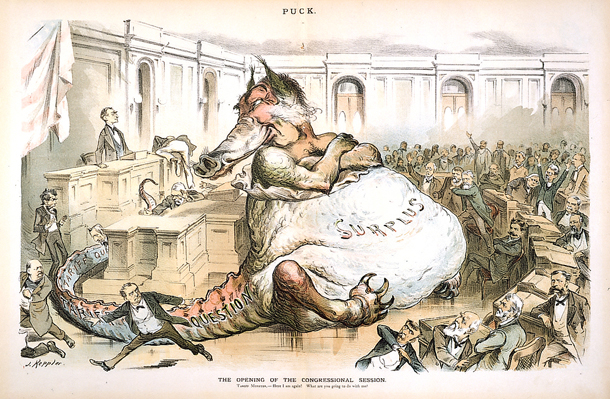 |
| Puck, December 7, 1887 |
A possible solution, therefore, was to leave the high tariff rates alone and slash the federal excise taxes, which were levied mainly on alcohol and tobacco. The point was not to give these items away for free, as the cartoon suggests -- "free whiskey," "free tobacco" -- but it definitely was to reduce their prices through tax cutting. If you favored free trade, as Puck and the Democrats did, you would have wanted to keep the high domestic excise taxes instead of the high tariffs.
"If Harrison and Protected Monopoly are victorious," Puck was warning, children (and cats) would start knocking back the whiskey -- an argument that Democrats would have found especially delicious because of the Republicans' periodic bouts of moralistic temperance agitation. Not to mention the decision it forced on a potentially significant third party -- the Prohibitionists.
"Home comforts for the laborer and his family." When Blaine and the Republicans bless a home, they don't stop with debasing the people. They turn the cat into a drunkard too.


